

The ultimate objective of the IPSF is to scale up the mobilisation of private capital towards sustainable investments. The IPSF therefore offers a multilateral forum of dialogue between policymakers that are in charge of developing sustainable finance regulatory measures to help investors identify and seize sustainable investment opportunities that truly contribute to climate and environmental objectives. Through the IPSF, members can exchange and disseminate information to promote best practices, compare their different initiatives and identify barriers and opportunities of sustainable finance, while respecting national and regional contexts. Where appropriate, willing members can further strive to align their initiatives and approaches.
See also:
Members
The founding members of the IPSF, that was launched on 18 October 2019 by the European Union, are the relevant authorities of Argentina, Canada, Chile, China, India, Kenya and Morocco.
Since then, Australia, Hong Kong Special Administrative Region of the People’s Republic of China (Hong Kong SAR of PRC), Indonesia, Japan, Malaysia, New Zealand, Norway, Senegal, Singapore, Sri Lanka, Switzerland and the United Kindgdom also joined the IPSF. Together, the 20 members of the IPSF represent 58% of greenhouse gas emissions, 51% of the world population and 54% of global GDP.
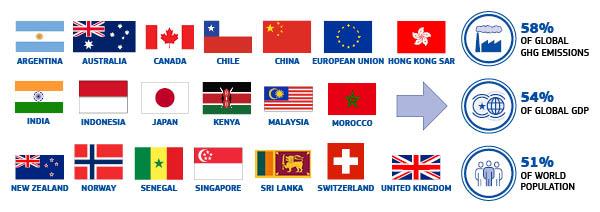
The following jurisdictions’ authorities are part the IPSF along with the European Union
- Argentina: Ministry of Treasury
- Australia: Treasury
- Canada: Department of Finance
- Chile: Ministry of Finance
- China: People’s Bank of China
- European Union: European Commission
- Hong Kong Special Administrative Region of the People’s Republic of China (Hong Kong SAR of PRC): Monetary Authority and Securities and Futures Commission
- India: Ministry of Finance
- Indonesia: Ministry of Finance
- Japan: Financial Services Agency
- Kenya: The National Treasury
- Malaysia: Ministry of Finance of Malaysia
- Morocco: Ministry of Economy and Finance
- New Zealand: Ministry for the Environment
- Norway: Ministry of Finance
- Senegal: Ministry of Finance and Budget
- Singapore: Ministry of Finance and Monetary Authority
- Sri Lanka: Central Bank of Sri Lanka
- Switzerland: Federal Department of Finance
- United Kingdom: HM Treasury
Observers
The work of the IPSF is informed by twelve observers
- the Coalition of Finance Ministers for Climate Action
- the European Bank for Reconstruction and Development
- the European Development Finance Institutions
- the European Investment Bank
- the IFRS Foundation
- the International Monetary Fund
- the International Organisation of Securities Commissions
- the Network for Greening the Financial System
- the Organisation for Economic Co-operation and Development
- the United Nations Environment Programme – Finance Initiative
- the United Nations Development Programme
- and the World Bank Group.
Main steps
Launched in October 2019, the IPSF is today acknowledged as a key network of policymakers that share best practices and compare sustainable finance approaches and tools with a view of making them more comparable and interoperable. This is line with the indications of the G20 Sustainable Finance Working Group (SFWG) which to the IPSF is key knowledge partner.
- 14 November 2024
In its fifth year, the IPSF focused on three important policy areas:
- the comparison of taxonomies
- transition finance
- biodiversity
Marking the 2024 IPSF annual event, held on 14 November 2024 under the Singapore pavilion at COP29, the IPSF published and presented the following reports detailing its activities:
- IPSF annual report 2024
- Common Ground Taxonomy Instruction Report – updated
- Common Ground Taxonomy Activity Tables– updated
- Common Ground Taxonomy Multi-Jurisdiction Activity Tables
- High-Level Overview of Taxonomies and sustainable finance landscape in IPSF Members
- Stewardship and engagement in transition finance note
- Press release on the Multi-Jurisdiction Common Ground Taxonomy
- 15 & 19 July 2024
The International Platform on Sustainable Finance (IPSF) organised a webinar to promote knowledge‑sharing related to the common ground taxonomy (CGT) comparison exercise.
This initiative aimed to further establish the CGT as a tool for enabling interoperability and comparability between taxonomies, serving as a reference for research and comparison in alignment with the principles outlined in the G20 sustainable finance roadmap.
The webinar consisted of two sessions – one on 15 July, and one on 19 July – featuring the same presentation in each. The presentation and the recording of the webinar are available on the webinar page.
- 4 December 2023
In its fourth year, the IPSF focused on three important policy areas
- social finance
- transition finance
- the comparison of taxonomies
Marking the 2023 IPSF annual event, held on 4 December 2023 under the EU pavilion at COP28, the IPSF published and presented three reports detailing its activities:
- November 2022
In its third year, the IPSF continued the work on two important policy areas (i) comparison of taxonomies and (ii) transition finance. To mark the 2022 IPSF annual event, held on 9 November 2022 under the EU pavilion at COP27, the IPSF published and presented two reports detailing this activity
- June 2022
Following the publication of the Common Ground Taxonomy Instruction Report in November 2021, the IPSF launched a call for feedback to consult stakeholders on the CGT activities’ table. The consultation ran from 4 November 2021 until 14 January 2022. In light of the feedback received and further assessments, the CGT activities’ table has been updated with additional activities contributing to climate change mitigation. The current version of the CGT covers 72 climate change mitigation activities that share common ground for both the EU and China taxonomies with regard to the “substantial contribution” criteria.
- February 2022
The transition to a climate neutral and sustainable economy is an ongoing process. Financing the transition of all economic sectors and actors, whatever their starting point, and including but not limited to high emitting sectors and activities, raises certain challenges. With the ultimate objective to support the scaling up of financial flows and therefore accelerate the global transition to a climate neutral and sustainable economy, the IPSF established a working group to explore how sustainable finance alignment approaches such as taxonomies, labels and portfolio alignment metrics, as well as corporate strategy and disclosures may integrate transition considerations.
- 4 November 2021
In 2021, the work of the IPSF focused on two important policy areas (i) comparison of taxonomies and (ii) sustainability-related disclosure. At the occasion of the IPSF Annual Event organised under the EU Pavilion at the COP26 on 4 November 2021, the following three reports have been published and presented, together with a statement reaffirming IPSF members’ commitment to international cooperation in the development of globally comparable and interoperable sustainability approaches and tools to identify, verify and align investments with sustainability goals, including definitions and taxonomies, taking due account of local specificities and transition considerations.
- IPSF annual report 2021
- IPSF Common Ground Taxonomy Instruction Report
- IPSF report on ESG disclosure
- IPSF COP26 Statement
The IPSF also launched a stakeholders' consultation on the CGT activities’ table that ended on 14 January 2022. The feedback has been carefully considered when updating the CGT activities’ table.
- September 2021
As part of the 2021 priorities of the G20 SFWG, the IPSF together with UNDESA have delivered an input paper setting our 7 high level principles and 10 recommendations to enhance comparability and interoperability of approaches to align investments with sustainability goals.
IPSF-UNDESA G20 SFWG input paper “Improving compatibility of approaches to identify, verify and align investments to sustainability goals"
- 16 October 2020
A first public report on the work of the IPSF was published at the one-year anniversary event of the IPSF that took place on 16 October 2020 on the margins of the IMF annual meeting. The report summarises the IPSF activities of the preceding year, the global trends in sustainable finance initiatives; a first-round mapping and comparison of existing initiatives and an overview of sustainable finance plans in the pipeline in all member jurisdictions.
- 18 October 2019
On the margins of the International Monetary Fund (IMF)/World Bank annual meetings in Washington DC, the European Union launched together with relevant authorities of Argentina, Canada, Chile, China, India, Kenya and Morocco the International Platform on Sustainable Finance (IPSF). The event was hosted by Kristalina Georgieva, Managing Director of the IMF, and Valdis Dombrovskis, Executive Vice President of the European Commission with the participation of Yi Gang, Governor of the People’s Bank of China, and Ukur Yatani, Cabinet Secretary for National Treasury of Kenya.